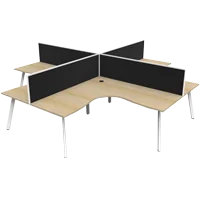

Choose a corner desk by measuring its complete footprint, confirming the orientation and planning where your equipment, chair and storage will sit. The Choose stackable chairs by checking three arrangements: the room when people are seated, the chairs when stored, and the route between them. A chair that works in a training session can still be awkward to move or store once the session finishes.
For Australian offices, training providers and community venues, the purchasing question is often about repeated changeovers. How quickly can the team clear a room, where will the chairs go, and will the same seating suit the next activity?
Start with the training and event chair range, then assess the complete routine before committing to a quantity.
Map the Room’s Busiest Changeover
Describe the two layouts staff move between most often. These might be rows for a presentation and table groups for a workshop, or a fully seated room and an open activity space.
Record how many chairs each layout uses, where surplus chairs wait and who moves them. Include tables, presentation equipment and bags in the plan. A clear room on a drawing can become crowded once those items arrive.
Test the layout with actual chairs where possible. Check access to seats and the space needed to pull a chair away from a table. Confirm the venue’s approved capacity and access requirements separately; fitting more chairs into a room does not establish a suitable occupancy.
Calculate Quantity From Simultaneous Use
Count chairs needed across rooms that operate at the same time. Do not count the same shared chairs twice simply because they appear in two alternative layouts.
For example, a hypothetical venue needing 36 chairs in one room and 20 in another at the same time needs 56 available seats before any justified spare allowance. If the second activity happens after the first and chairs can be moved, the purchasing requirement may differ.
Allow separately for seats temporarily unavailable for cleaning or repair. Base that allowance on your operating needs rather than buying an arbitrary extra percentage.
Bulk packs can simplify ordering when their quantities match the requirement. The 100 Pippee Stackable Chairs pack contains 100 chairs. Compare that quantity with your actual seating and storage plan before choosing the pack.
Check Stack Limits and Stored Dimensions
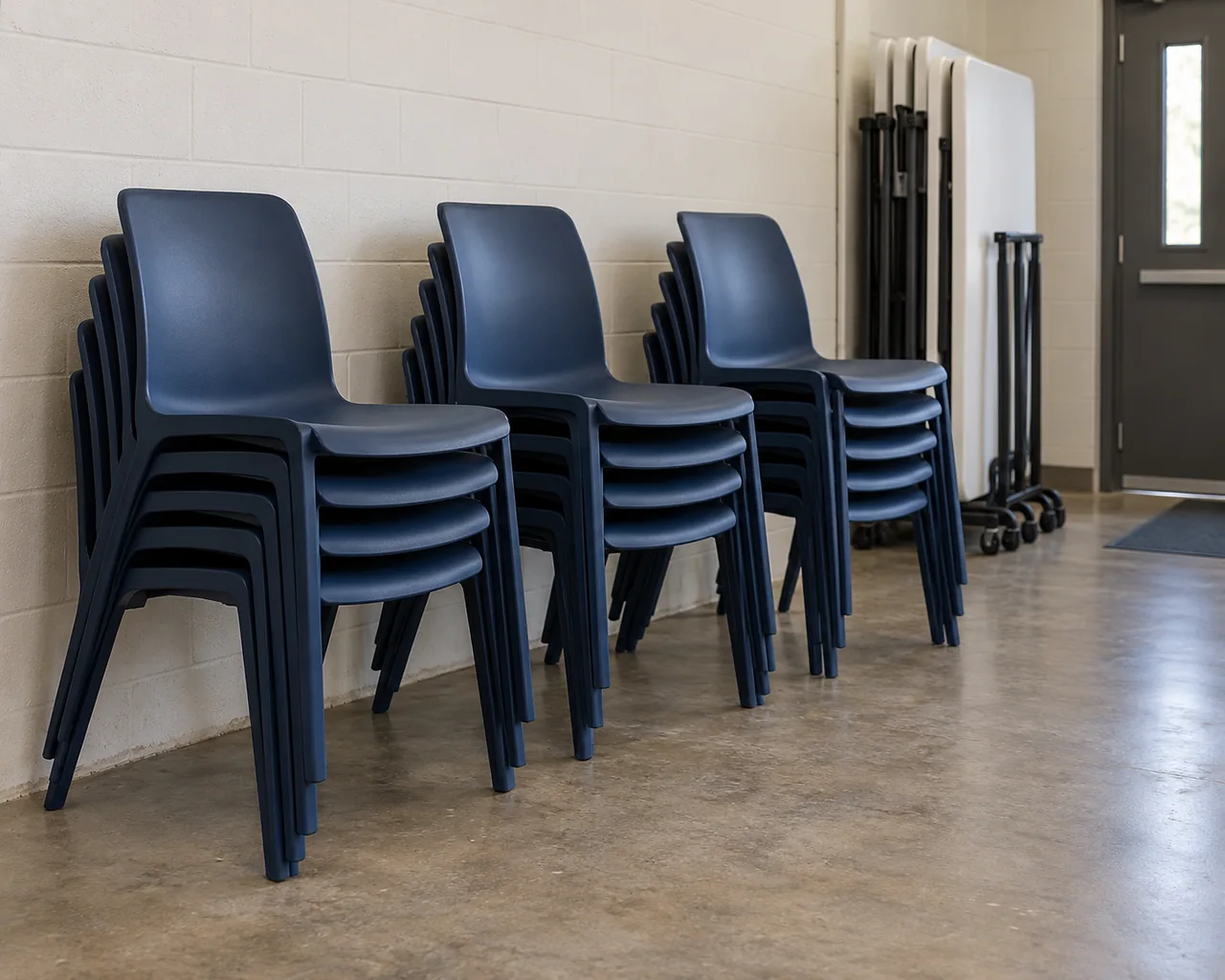
Stackability is a product-specific feature. Confirm the permitted stack quantity for the exact chair, together with any different limits that apply during transport.
The Pippee Stackable Plastic Chair has a one-piece polypropylene body and is listed as stackable up to 25 chairs. That figure does not establish the height of a finished stack or authorise moving a 25-chair stack by any particular method.
Ask for the footprint and height of the intended stack. Check them against:
- The clear storage area and ceiling height.
- Door openings and overhead obstructions.
- Space needed to approach and remove chairs.
- Other equipment stored in the same room.
Do not calculate stack height by multiplying one chair’s overall height. Nested chairs overlap, and the resulting dimensions depend on their design. A lower working stack may be more practical for the staff and space involved.
Confirm the Handling Method Before Buying a Trolley
A chair trolley needs to suit the exact chair model and permitted load. A trolley described as suitable for stackable chairs is not automatically compatible with every stackable chair.
Ask which trolley or handling method the supplier specifies. Confirm the number of chairs it can carry, how they are supported and whether restraints are required. Follow the applicable instructions and your workplace’s handling procedures.
Walk the complete route from storage to the room. Check corners, thresholds, floor transitions and lift access. Include the space needed to turn and stop, not just the width of a straight corridor.
Avoid relying on staff carrying large stacks because a suitable transport arrangement was left out of the order.
Trial the Seat for the Actual Session

Storage efficiency is only useful if the chair also suits its occupants and the activity.
Try a sample during a representative meeting or training session. Check the seat dimensions, back support, ease of sitting and standing, and compatibility with the proposed tables. Confirm any published user weight rating for the exact model.
Consider whether some positions need a different chair configuration. A single matching model may simplify storage, but the room should still accommodate the people using it.
Include Reset and Maintenance in the Quote Brief
Before ordering, record the chair model, quantity, finish, permitted stack arrangement, handling equipment and storage location. Ask for care instructions and confirm which components are included.
Include delivery access and the place where chairs will be unpacked. Nominate who will inspect the order, remove packaging and put the seating into service.
After installation, use a simple reset routine: check chairs for damage, clean them as directed, return them to the agreed storage positions and keep access clear. Remove damaged chairs from use for assessment.
To compare a defined seating solution, request a stackable-chair quote from Epic Office Furniture. Include both room layouts, simultaneous seating demand, storage measurements and the route between storage and use.